
On this page
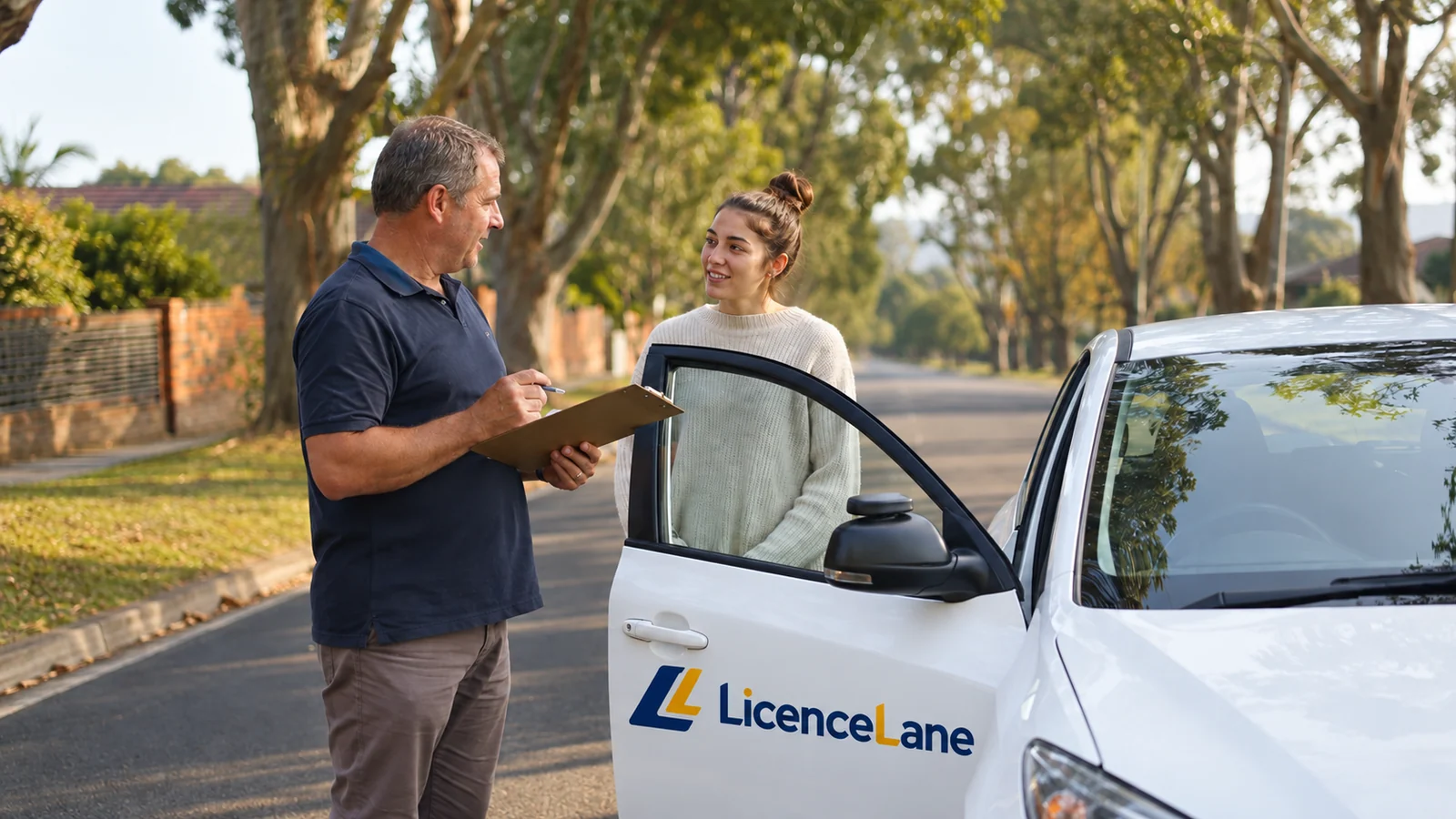
The NSW Driving Test assesses whether you can make safe driving decisions without coaching. A successful test day depends on more than your ability behind the wheel: you also need the correct eligibility, documents, vehicle and appointment arrangements. An instructor's preparation lesson and car can be useful, but they do not replace the official test booking.
This guide covers the ordinary car test. Overseas conversion applicants should also read the NSW conversion requirements, particularly the rules affecting their authority to drive after an unsuccessful attempt.
Confirm that you are eligible to attend
For the standard under-25 learner pathway, you must be at least 17, have held your learner licence for 12 months, passed the Hazard Perception Test and completed the required logbook. The ordinary logbook requirement is 120 hours, including 20 at night, unless an exemption applies.
Applicants aged 25 or over do not need the ordinary learner logbook or 12-month holding period, but must still meet the applicable testing requirements. Overseas applicants can have a different pathway. Check the route applying to your own licence rather than selecting an appointment based only on available dates.
Look at your licence expiry and any conditions before paying for private support. If you are unsure whether a suspension, transfer or earlier application affects your eligibility, resolve that with Service NSW first. An instructor's availability cannot make an otherwise ineligible test proceed.
Match the government appointment and private booking
Book the Driving Test through the official NSW service. Save the centre, date, appointment time and booking reference. Then check that any instructor and suitable vehicle you intend to use are available for the full period needed.
Allow for the meeting point, warm-up lesson, travel to the centre, early arrival and the return journey. A support booking starting at your government appointment time leaves no room for preparation or travel. Conversely, an instructor meeting time is not the time at which the testing officer expects you at the counter.
Check whether the private service includes the test vehicle and the instructor's waiting time. Read whether government fees are included or payable separately. Keep written confirmation of both bookings, especially if the learner's pickup address differs from the assessment centre.
Review the skills that the test measures
NSW's official Driving Test guide explains the assessment approach. Use it to understand how safe observation, road positioning, speed selection, decisions and responses to hazards work together. Your task is to drive safely in the situation that exists, not to perform a rehearsed sequence for a particular examiner.
Ask your instructor to identify specific behaviours that still require reminders. Examples might include noticing a changing speed zone, checking before a lane change or choosing a safe gap. Practise those tasks in suitable conditions until the response becomes consistent.
Try a preparation drive with fewer prompts. Afterwards, discuss where you made decisions independently and where coaching was still needed. If the instructor had to intervene repeatedly, further practice may be more useful than keeping an early appointment simply because it is already booked.
Check the test vehicle before the day
You must provide a registered, roadworthy and suitable vehicle. Check the official vehicle requirements before deciding to use your own car or an instructor's. A car that is comfortable for normal travel may still have a defect or configuration that prevents the test from proceeding.
Check tyres, lights, indicators, mirrors, seatbelts and the windscreen, and secure loose items. Make sure the vehicle is clean enough for the assessment. If something needs repair, arrange it early rather than hoping the testing officer will overlook it.
Learn how the controls work in the actual car you will use. NSW requires safety systems such as autonomous emergency braking and traction control to remain on for the test. You still need to demonstrate safe driving rather than rely on those systems to make decisions for you. Follow the current official guide for any other equipment restrictions.
Prepare your documents and logbook
Use the official checklist for your circumstances. It includes proof of identity, the completed licence application, any required logbook and glasses or contact lenses needed for driving. Overseas applicants may need additional identity and translation documents.
For a paper logbook, review the hours, learning goals and signed completion declaration before the appointment. If you use the approved app, NSW requires submission at least 48 hours before the test. This is a government logbook-submission requirement, separate from any private lesson cancellation policy.
Take an accepted payment method for any licence-issue charge after a pass. Check the particular centre's payment options rather than assuming cash will be accepted. Keep the appointment details accessible without having to search through messages while driving.
Know what happens when you arrive
NSW asks applicants to arrive at least 15 minutes early, park in the test parking area and report at the counter. Allow additional travel time so ordinary traffic does not turn the journey into a rush. Read your appointment confirmation for any centre-specific instructions.
The testing officer will explain the process. Ask about an instruction you do not understand before the test begins. During the assessment, the officer directs the route but cannot coach you on how to drive.
Only the applicant, testing officer and, sometimes, a monitoring officer are permitted in the test vehicle. Your instructor does not accompany you inside the car during the NSW test. Agree beforehand where the instructor will wait and how you will meet afterwards.
Manage nerves without changing your driving
A warm-up can help you settle into the vehicle and identify any last practical questions. Use it to practise familiar skills, not to attempt a large number of new tasks. Check the seat and mirrors again if another person has driven the car since your last lesson.
If you miss a direction, keep driving safely and seek clarification rather than making a sudden turn or lane change. Do not assume one uncomfortable moment has decided the whole result. Continue applying the road rules and responding to the conditions in front of you.
Plan food, rest and travel sensibly. Tell the instructor early if illness or another issue affects your ability to drive safely. Review the government and private booking arrangements separately if a change is needed.
Plan for either result
After an unsuccessful attempt, use the officer's comments to plan further practice. NSW requires at least seven days before another attempt. Arrange a fully licensed person for the journey afterwards; do not assume you can drive home alone, particularly if you were relying on an overseas licence.
After a pass, complete the licence-issue process and understand the conditions applying to your P1 or other issued licence. A positive assessment result should not be treated as a substitute for the authority to drive that Service NSW issues.
LicenceLane can help you find available independent instructors for NSW lessons and test-day support. Confirm the exact service inclusions and vehicle arrangements before booking. A private support purchase does not itself reserve, reschedule or cancel your government Driving Test.
Official sources
Official pages checked on . The authority's page prevails over this guide.